SOUNDS AND SWEET AIRS, July 28, Church of the Holy Faith
PERGOLESI’S STABAT MATER, Aug. 1, Loretto Chapel
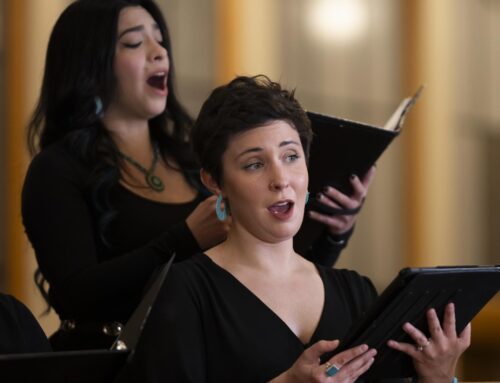
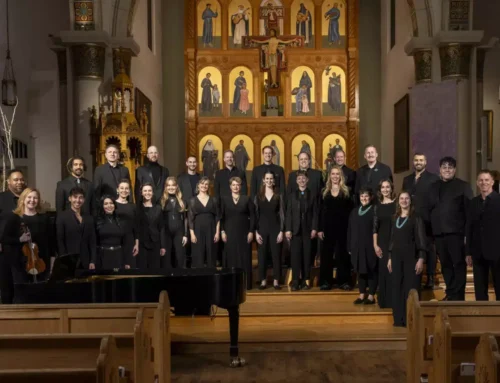
The Santa Fe Desert Chorale added its voice to the city’s Shakespeare saturation during this quadri-centennial of the author’s death by presenting a program called Sounds and Sweet Airs. The title, of course, is drawn from The Tempest, the words being adapted from Caliban’s description of the magical island he and all the other characters inhabit: “The isle is full of noises,/Sounds, and sweet airs that give delight and hurt not./Sometimes a thousand twangling instruments/Will hum about mine ears, and sometime voices/That, if I then had waked after long sleep,/Will make me sleep again.”
The program was constructed by Richard Sparks, who, as the evening’s guest conductor, led an ensemble comprising 16 of the Desert Chorale’s singers. Its musical heart was Songs of Ariel, a set of five a cappella pieces written in 1949-50 by the Swiss composer Frank Martin. It was the first step in Martin’s Tempest obsession, which culminated in his opera Der Sturm, premiered in 1956. “What attracted me to Shakespeare’s The Tempest,” he said, “is, apart from its poetic allure (which should appeal to any musician), the infinite psychological richness of the various characters. There is a range of human types that one finds in no other piece of theater.” This sequence of movements suggests the diverse but precise characterization Martin admired in the play. Solid pacing and rhythmic precision marked the interpretation, and the group sang with firm, well-blended tone. The singers landed securely on their pitches in Martin’s dense chords and, when necessary, adjusted their intonation instantly to keep the harmony aligned just so. Particularly enchanting was the second of the songs, “Full fathom five,” where the choir’s slowly undulating lines depicted the watery depths. Several members of the chorus are called on to deliver solo passages in this score. The most impressive of these expanses came in the fourth movement, “You are three men of sin,” where mezzo-soprano Mitzi Westra delivered her condemnation of the play’s malefactors with gripping intensity.
Vaughan Williams’ Three Shakespeare Songs fora cappella chorus also drew ensemble excellence from the group, which Sparks had obviously prepared with careful attention to dynamics, diction, and texture. The concert’s opening set was Fancies I, five movements by the Swedish composer Sven-Eric Johanson. They are attractive pieces and probably not more than that, but here they benefited from the admirable musicianship of Nathan Salazar, who assisted at the piano. The naturalness of his phrasing was underpinned by buoyant rhythmic allure.
The remainder of the repertoire was middlebrow. Witches Blues, by Bob Applebaum, was a jazz-inflected piece of some five minutes’ duration, which in the event seemed about five minutes too long. It sets the passage in Macbeth in which the three wayward sisters sing about how “thrice the brinded cat mew’d,” and the composer predictably has his singers imitate said feline. The sopranos applied themselves to this task with relish. From the late jazz pianist George Shearing came a cycle called Songs and Sonnets, again with Mr. Salazar as the impressive pianist, eight pieces that could become mired in treacle and that ended up feeling like a whole Christmas album of John Rutter arrangements, which I don’t mean in a good way. An exception came midway through with “Who is Sylvia,” where long-spanning lines encompassed great elegance. In that movement, Sparks took a seat and had the choir sing conductorless; the performers scored high marks not just for their sustained lines but also for imaginative links between those phrases. One was glad Sparks could sit back for a minute to enjoy the fruits of his preparation. This came across not as an ostentatious trick, but rather as a reflection of the bearing he displayed throughout the concert, conducting in a clear, economical manner and always managing to cast the spotlight on the singers rather than on himself.
Actor Anna Farkas provided an introduction to the concert and sprinkledrecitations from Shakespeare and setups to the choral numbers all the way through. It was thoughtful to give some “solo attention” to Shakespeare, who was a pretty fair wordsmith in his day. Yet there were too many of these narrations — at least 15, I would think, although at some point I stopped counting. Half as many, or even a third, would probably have been more effective. Pleasant winsomeness ran through Farkas’ delivery in all of them except for Benedick’s soliloquy “I do much wonder that one man,” from Much Ado About Nothing, in which she invested some elements of acting. Perhaps that degree of characterization would have provided the variety one missed. Clearly it was not her intent to render anything but a declamation, except in that instance. As it was, the recitations seemed not more than a largely unconnected overlay on the musical selections. All told, they gave some delight and hurt not.
A few nights later, the Desert Chorale presented a performance of Pergolesi’s Stabat Mater, plus a few short Baroque pieces, again with a guest conductor — Harry Bicket, the chief conductor of Santa Fe Opera and a noted exponent of historical performance. I applaud the Desert Chorale’s decision to include guest conductors in its lineup this summer, an experiment that may prove valuable in enlarging the group’s musical breadth. This was an unusual venture for the organization since it was not a choral concert. The vocal component was handled by just two Desert Chorale members, soprano Meredith Ruduski and mezzo-soprano Helen Karloski. An accompanying string quintet was populated by musicians from Santa Fe’s year-round scene. I am happy to report that they did not twangle. Bicket led from the organ, opening the evening with a clearheaded, carefully plotted solo-keyboard rendition of Sweelinck’s variations on the Protestant hymn “Mein junges Leben hat ein End.” Two short sacred works followed: Henry Purcell’s Evening Hymn and John Blow’s Paratum cor meum, the latter providing the singers with opportunities to sing Monteverdian divisions in rollicking thirds over a ground bass.
Pergolesi composed his Stabat Mater in early 1736, not many weeks before his death at the age of twenty-six. This popular work is performed a lot — Santa Fe Pro Musica gave it its last local airing in April 2015 — but it is rather a strange piece. Although its grief-laden text describes Jesus’ mother lamenting her son’s death by crucifixion, its musical style ranges from the mournful to the downright jovial, the latter reflecting the fashion of the composer’s Neapolitan operas. Ruduski sang the soprano line with bright, open tone, but a stronger impression was made by Karloski, whose rendering of the mezzo-soprano part was spot-on for the assignment. Her voice is beautifully suited for oratorio, and the sincerity of her delivery, along with her poised bearing and physical presentation, forged an almost palpable connection with the audience