Pasatiempo | Michael Wade Simpson | Link to article
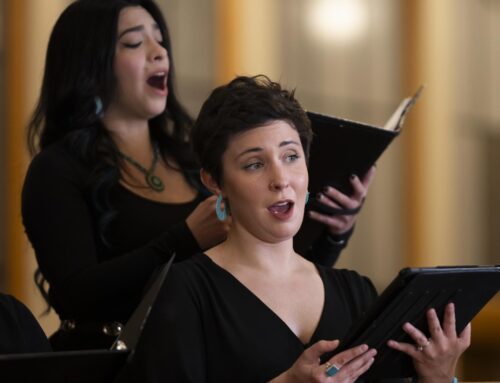
Let’s say Group A consists of choral music lovers who have no qualms about squeezing into church pews to hear sacred music from the Renaissance, and Group B is made up of young a cappella fans who tweet one another before, during, and after episodes of TV shows Glee and The Sing-Off. Joshua Habermann, music director of the Santa Fe Desert Chorale, has a plan to bring both subsets, dissimilar though they might be, together. It’s called Voasis, an eight-member chorale offshoot whose raison d’être is rock/pop a cappella and counts its own music director, Greg Jaspere, among the voices. “We’re trying to break down the barriers between the two groups,” Habermann explained. “We jokingly call Voasis the gateway drug to the Desert Chorale.”
The producer for Voasis is Deke Sharon — a longtime friend of Habermann’s — who produced The Sing-Off and served as music director for the 2012 film Pitch Perfect, a musical comedy. Habermann said he and Sharon met as singers in a pop/rock vocal group they both joined right out of college and have stayed in touch ever since. “I approached Deke at one point and told him that we needed to do something together,” Habermann recalled. The Desert Chorale director may have headed, professionally speaking, into the classical wing of choral music, while Sharon, who has a degree from the New England Conservatory, turned away from classical roots to make a career for himself in a more commercial world (where he’s credited by many for creating the dense, vocalists-doing-instrumentals sound of contemporary a cappella), but Habermann said that this contrast is partly the point. “The two styles need not be enemies. We are constantly asking ourselves, How can we make the world bigger? My feeling as a musician is that if we are going to survive, crossover is a big part of that.”
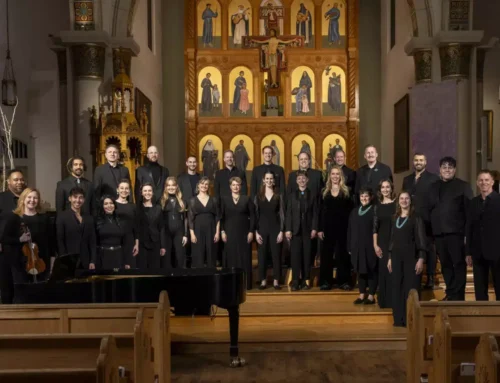
In a way, having Voasis on tap may have allowed Habermann the freedom to pursue a slightly more classical vein for the Desert Chorale’s four programs in five venues (two are in Albuquerque) this summer, which include performances of Mozart’s Requiem with the Santa Fe Symphony featuring renowned soloist (and part-time local resident) mezzo-soprano Susan Graham. The New World: Music of the Americas, offers a variety of sacred and secular music from the cultures of North, Central, and South America; Spanish Mystics, timed to coincide with Spanish Market, performs Renaissance and Baroque music from Spain with accompaniment on lute and guitar by Richard Savino. A Romantic Evening With Brahmshighlights some of the brilliant orchestral composer’s lesser-known small-scale pieces for chorus and piano. The 24-member chorale’s summer season begins on Thursday, July 10. Voasis appears at Warehouse 21 for four shows from Aug. 15 through Aug. 17.
The New World: Music of the Americas highlights American spirituals, 20th-century music from Haitian and American composers, and Spanish-language pieces arranged by Conrado Monier and Electo Silva. A selection from Reincarnations by Samuel Barber, whom Habermann calls one of the great treasures of choral composing, is performed, along with works of two young American composers, Dan Forrest and Sydney Guillaume. The program opens Thursday, July 10, at the Cathedral Basilica of St. Francis of Assisi and July 27 at the Cathedral Church of St. John in Albuquerque. “Presenting Spanish, Mexican, and South American music in Santa Fe makes perfect sense,” Habermann said. “We’re the crossroads of all these cultures. Besides, I love it. I used to be a Spanish teacher — I’m from California, and I’ve lived in border states my whole life. I often think I’m a Latin American person trapped in a Scandinavian body.”
Spanish Mystics centers on music from the Renaissance by composer Tomás Luís de Victoria (circa 1548-1611). If you’re familiar with the work of one of Victoria’s contemporaries, the Italian composer Palestrina, the difference between them is like night and day, Habermann pointed out. “Palestrina is the Apollonian version of things — everything is beautiful and shiny. Victoria’s music is like Goya’s art — he leaves the problems in. Sometimes the harmonies are crunchy. Think of Goya’s painting Saturn Devouring Children: there’s a lot of darkness.” The Spanish Baroque will be represented by pieces that offer dancer rhythms, Habermann said. The program, which includes pieces by Javier Busto (born in 1949), a physician from the Basque region of Spain who also happens to be widely known as a choral conductor and composer, opens July 17 at Loretto Chapel.
A Romantic Evening With Brahms, which opens July 22 at the First Presbyterian Church, offers secular music the composer published with a market of amateurs in mind. “The 19th century saw the rise of the middle class (in both Europe and the United States). People would gather in their homes around pianists and sing. The music is about romance, love, and night. There’s a sweetness to the music, but Brahms was a melancholy fellow — it’s the sweetness of lost love,” Habermann observed. Gypsy songs, piano interludes performed by Debra Ayers (“they have one of the nicest pianos in Santa Fe at First Presbyterian,” he confided), and little masterpieces such as op. 92 (“O schöne Nacht”) and op. 31 (“Drei Quartette”) complete the evening. “This music is sublime,” Habermann said. “It’ll be a good date night.”
Mozart’s Requiem, which appears Aug. 7 and 9 at the Cathedral Basilica of St. Francis of Assisi and Aug. 10 at Immanuel Presbyterian Church in Albuquerque, features a chamber-scaled version of that piece. The chorus slightly expands its forces to 32 voices, but that’s still a small number compared with some of the big symphony ensembles (like the one Habermann directs in Dallas) that regularly take this work on. “It works with 130 or 32, but our version is more historically informed — the way it might have been presented in Mozart’s time.” The chorale uses a modern version of the score by Robert D. Levin. Mozart died before finishing his Requiem, and Franz Xaver Süssmayr, a copyist for the composer, assumed the task of extrapolating his style and thematic directions, completing the work not long afterward. This version has been traditionally presented, until now. According to Habermann, the new version is not an attempt to rewrite Süssmayr’s work, but to take a fresh look at the original manuscript, with an eye to correcting earlier stylistic inconsistencies. According to Habermann, Levin, a musicologist, did just a touch-up rather than reconstructive surgery.